
4-Step Goal-Setting Framework for School Leaders

School leaders face a never-ending list of priorities. For those in high-stakes roles like CEOs, COOs, and Department Heads, the pressure is even greater. Without clear goals and the right systems in place to keep you and your team focused, it’s easy to get caught up in the chaos and lose sight of what truly matters.
Meghan Mitchell, Chief Academic Officer at Valor Collegiate Academies, understands these challenges firsthand. She has developed a four-step goal-setting framework that empowers school leaders to stay on track and make meaningful progress throughout the year. In this post, we’ll break down each step, designed to help you and your team manage time and priorities more effectively.
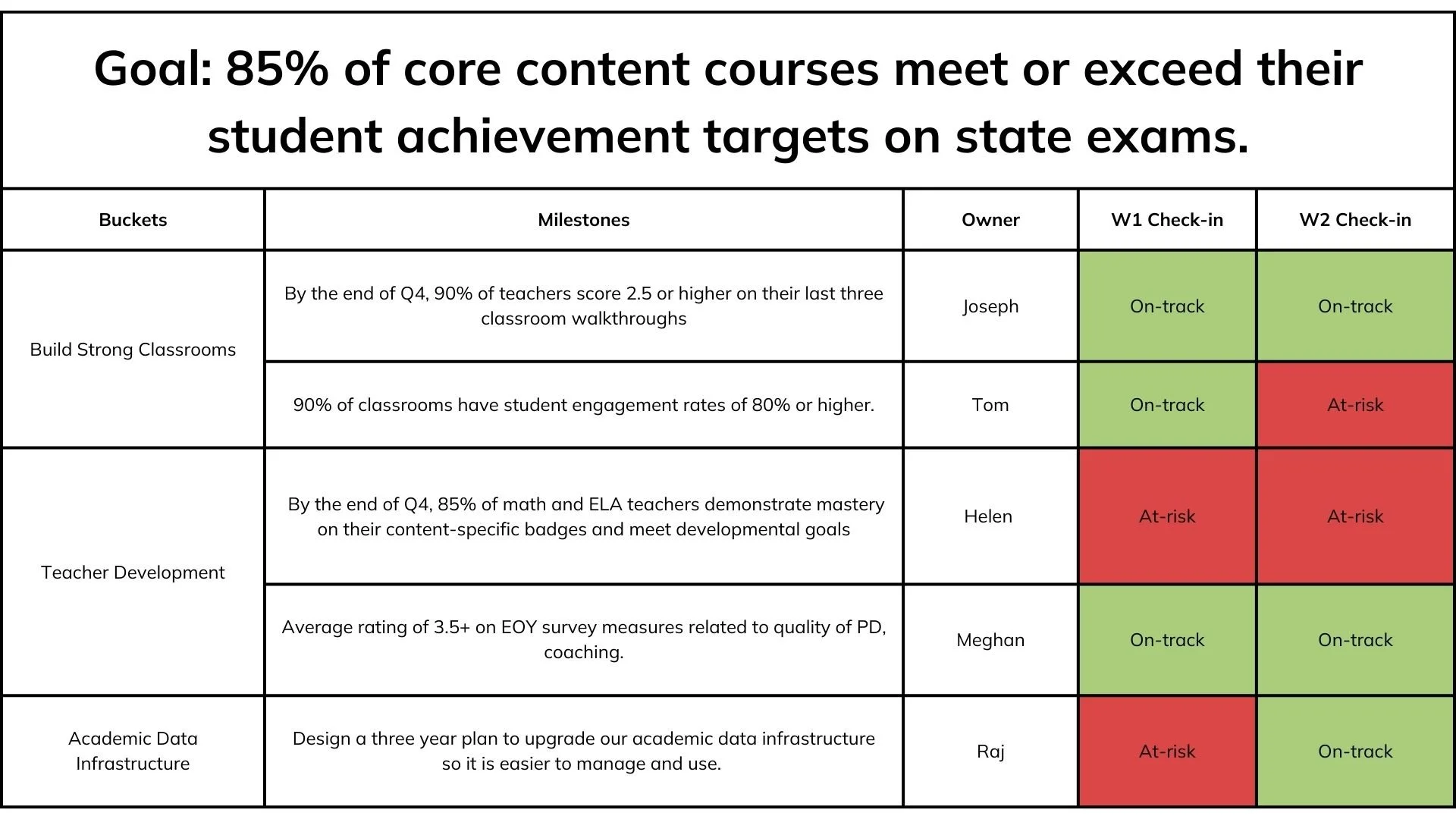
By following the steps in this post, you'll be able to create a clear, organized spreadsheet outlining your goals, key focus areas, owners, and check-in status—helping you stay on track throughout the school year. Here's an example of what your finished spreadsheet could look like!
1. Identify Your Big Goal
Every successful school year starts with a clear goal. As a school leader, it's important to figure out the main goal your team is working toward. This big goal should guide everything you do. Think about what you want to achieve by the end of the school year and how it fits with your school's mission. When everyone knows the main goal, your team stays focused and ensures each project helps you get closer to that goal. Without a clear goal, it’s easy to get distracted by tasks that seem urgent but don’t really matter.
For example, a big goal for an academic team could be: “85% of core content courses meet or exceed their student achievement targets on state exams.” The fewer your goals, the better!
2. Break your Big Goal into Buckets
Once you have your big goal, break it down into sections or "buckets." Each bucket is a piece of the puzzle that helps you reach your big goal. Think of it like this: what are the main systems you need to focus on to make your big goal happen? For example, if your goal is for 85% of core courses to meet or exceed their student achievement targets, you might create buckets like: (1) Build Strong Classrooms, (2) Teacher Development, and (3) Academic Data Infrastructure.
To figure out what your buckets should be, simply ask: What systems need to be in place for you and your team to reach your big goal? Your milestones (which we’ll discuss in Step 3) will flow from these buckets. Don’t worry if you can’t identify all the buckets right away—you can always revisit this after Step 3.
3. Define Milestones, Performance Metrics, and Owners!
Once you have broken your goal into ‘buckets,’ the next step is to set simple milestones that show you are making progress toward each one. Remember, we want to break down a large organizational goal into clear, measurable parts you can track over time. These milestones help you gauge how close you (and your team) are getting to your bigger goal, so keep them specific and easy to measure. For example, if one of your buckets is Building Strong Classrooms, a milestone could be: "By the end of Q4, 90% of teachers score 2.5 or higher on their last three classroom walkthroughs," or "90% of classrooms maintain student engagement rates of 80% or higher." Clear markers like these make it easier to see how you are moving forward.
Now that you have set actionable milestones and performance metrics, the next step is to assign an owner to each one. If no name is attached, no one will feel responsible, and that’s a recipe for disaster. Assign each milestone to a specific team member who will take ownership of its progress.
4. Routine Tracking and Reviews
Setting goals is just the first step. You can't assume your team will stay on track without regular check-ins. Whether you automate the process or handle it manually, it's important to have a system for reviewing progress. This can happen weekly, monthly, or quarterly—whatever fits your workflow best. The more frequently you check in, the more opportunities you will have to learn and adjust. During these check-ins, be sure to clearly identify whether each milestone is on track, off track, or deferred (i.e., no longer relevant for the current cycle).
Bonus tip: As necessary, help your teammates create a week-by-week plan that breaks their milestones into daily tasks. This way, each team member can confidently answer the key question: “What do I need to do today to stay on track with my milestones?
Running a school comes with an endless to-do list, making it easy to lose sight of key goals while managing urgent tasks. While this goal-setting framework isn’t a cure-all, it can be a powerful starting point for building a culture of accountability and success within your team. By focusing on these strategies, you can drive better outcomes for your students, your organization, and your school community.
About the Author
Meghan Mitchell is the Chief Academic Officer of Valor Collegiate Academies, which serves over 1,900 students across three campuses and consistently ranks in the top 5% of schools in the state for both growth and achievement. With two decades of experience in public education and a deep passion for learning, Meghan leads with a commitment to excellence and equity in education.
This article is an excerpt from one of Seminar’s expert-led workshops, which provides actionable insights on the topics most relevant to charter school teams. Each workshop is crafted to offer practical templates and strategies, empowering you and your team with knowledge to thrive. Seminar workshops are available to Seminar Core Members.