
Entering Hiring Season with Confidence and Data-Driven Systems

As hiring season ramps up, we often get caught up trying to fill vacancies as fast as possible. But there’s a piece we can’t afford to ignore: our talent data. It tells us where we’re strongest, where we risk losing key people, and what our workforce will need in the year ahead.
When we pay attention to these numbers—who’s leaving, who’s thriving, and why—we can plan better for the future. We can invest our energy where it matters most, rather than scrambling at the last minute. By putting data at the center of our hiring strategy, we can move beyond simply plugging holes and start building a stronger team for the long run.
Let me paint a picture you’ll recognize. It’s hiring season, and your inbox pings with the dreaded email: “Hey, how’s recruitment going? What’s our retention looking like?” A few years ago, my response would’ve been a vague, rambling mess, like the email below. Translation: I have no idea.
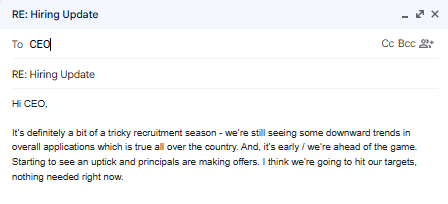
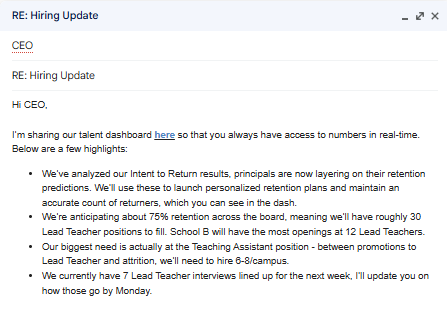
Then I built a system that changed everything. My emails became clear and data-driven (see below), backed by real-time insights on staffing needs, retention risks, and hiring priorities. Instead of scrambling, I could provide my leaders with a dashboard that gave them the answers they needed at a glance.
Data doesn’t lie—and it doesn’t panic. In this post, I’ll share the exact tools and tactics I used to turn hiring chaos into clarity and ensure my team enters every hiring season prepared.
1. The Network Hiring Tracker: Real-Time Data, Zero Guesswork
Early in my career, I relied on clunky applicant tracking systems that offered only surface-level insights. They told me how many candidates were in the pipeline—but not where they were in the process, who was slipping through the cracks, or which schools needed immediate attention.
So, I built a simple yet powerful Network Hiring Tracker (find a copy in the Seminar Toolbox). Here’s why it worked:
- Granular visibility – Each school had its own tab, feeding into a master dashboard that updated automatically.
- No more “I don’t know” moments – When the CEO asked about hiring and retention, I had clear answers: “We’re anticipating 75% retention, meaning 30 lead teacher openings. School B needs 12, and we’ve already lined up 7 interviews this week.”
- Total transparency – Leaders could access the dashboard anytime, eliminating the need for constant status updates. Instead, I could simply say: “It’s all here. Let’s talk priorities.”
With this system, hiring decisions became faster, more strategic, and far less stressful.
After experimenting with the Network Hiring Tracker, Brian King, Founder and Executive Director of Liberation Academy, shared his thoughts:
"I love how functional the Network Hiring Tracker is and how easily you can track all of the roles. I tend to be a visual person, and this makes it so much easier. It’s great for visual thinkers."
2. The Retention & Motivator Tracker: Personalization Over Platitudes
Retention shouldn’t be just about collecting survey data, but also about understanding what drives people to stay and acting on it. At Impact, we took a proactive approach, combining intent-to-return data with weekly principal check-ins to uncover the real reasons behind retention. Our data and action items included:
- Talent Value Score – A simple 0-to-3 scale, where 0 means “Not renewing” and 3 means “Renewal” (i.e., “must keep”).
- Key Motivators – What mattered most to each staff member? Leadership opportunities? More autonomy? Strong peer connections? Understanding these factors helped us tailor retention strategies.
- Targeted Weekly Action Plans – Principals focused on 1–2 high-value staff members each week, using personalized approaches to reinforce engagement and commitment.
Relevant: Site-Level Retention Tracker and Weekly Hiring Check-In Templates in the Seminar Toolbox.
During our workshop, we saw how personalized gestures can make a big impact on staff retention. Charter leaders shared a variety of creative ways they motivate and keep their strongest employees.
For example, Heather at Modern Montessori Charter School sends routine updates to teachers, ensuring they feel noticed and valued. Tatiana at Catalyst Public School created a “Share the Love” tracker for herself and her co-founder to regularly celebrate key team members. Elizabeth Simpson at Compass Collegiate Academy organizes Staff Surprise Days, where colleagues leave notes or small gifts to cheer each other on.
The impact? Fewer last-minute resignations, stronger staff relationships, and a school culture where people feel seen and valued.
P.S. You don’t have to wait until hiring season to check in on staff plans. The sooner you start those conversations, the better.
The Big Takeaway: Stop Reacting, Start Predicting
Hiring season doesn’t have to feel like a crisis. It’s not just about filling roles—it’s also about retaining top talent and making strategic additions that strengthen the team. With clear staffing needs, real-time data, and proactive retention strategies, you can approach hiring with confidence—building a team that lasts.
About the Author
Alex Horowitz led talent at Impact Public Schools in Washington during a period of significant expansion, where the network quadrupled in size and faced extensive hiring needs. He pioneered innovative tools, resources, and systems that ensured the schools remained fully staffed with exceptional teachers, even throughout the challenges of the pandemic and post-pandemic years. Alex is dedicated to empowering talent leaders with practical, easy-to-implement solutions that address the complexities of their roles.
This article is an excerpt from one of Seminar’s expert-led workshops. Seminar workshops provide actionable insights on the topics most relevant to charter school teams. Each workshop is crafted to offer practical templates and strategies, empowering you and your team with knowledge to thrive. Seminar workshops are available to Seminar Core Members.