
Impact’s AI Rollout Strategy: A Complete Implementation Guide for School Leaders
This past year, our team at Impact made a decision: we couldn't afford to treat AI like a side project. The demands on our educators — especially around personalization, data tracking, and communication — were only growing. And we knew we had to find a better way to support them.
What we needed was a thoughtful, values-aligned way to bring AI into our organization — not as a gimmick, but as a strategic investment in our people, our students, and our systems.
Here's what we've done so far and what might help if you're a school leader beginning this work.
First: Get Clear on Why You're Doing This
Before you even name a tool, you need to articulate the "why" for your community. For us, the push toward AI was driven by three things:
- To sustain personalized learning: Our model depends on analyzing student data and tailoring support. But the workload was becoming unsustainable.
- To navigate resource constraints: With looming funding shifts, we had to find ways to do more without adding burden.
- To prepare students for the future: AI isn’t optional. Our kids are growing up with it, and we have a responsibility to model ethical, effective use.
We don’t see AI as a replacement for educators. It can’t replicate human connection. But it can remove the repetitive tasks that keep teachers from building those connections in the first place.
We Built the Structure First, Then Chose the Tool
One of the earliest decisions we made was to set up the right governance structure. We formed an AI Steering Committee made up of leaders across instruction, operations, talent, and data. This cross-functional approach was crucial because each department brought different perspectives and needs to the table. Together, we drafted:
- AI Decision Grid: Clarifies who owns, approves, and gives input on AI use cases.
- AI Usage Guidelines: Based on pillars like safety, equity, bias checks, and accountability, built with staff input to ensure trust and alignment.
- Defined Roles: We named an overall AI Owner and department leads to avoid bottlenecks and ensure no team was left behind.
This structure helped prevent “analysis paralysis” and ensured AI integration reflected the diverse needs of our organization.
Getting Your Team on Board
The biggest question I get: "How did you handle the resistance?"
First, we led with our why. We explained that AI wasn't replacing our team, but amplifying what makes them unique. We highlighted what cannot be replaced by AI: the human connection and belonging that computers simply can't generate.
Second, we identified early adopters across departments. These were tech enthusiasts and team members who were respected voices and could have authentic conversations with hesitant colleagues.
Gemini Made Sense, But Only After We Did Our Homework
Once the structure was in place, we started evaluating tools:
- Surveyed staff to assess their AI experience (ranged from Magic School power users to complete beginners)
- Ran focus groups across departments to surface real use cases
- Met with vendors to understand what was available
- Tapped peer networks to learn from other organizations
Ultimately, Gemini won for us because it integrated with our existing Google Workspace, aligned with our privacy requirements, and matched the specific needs we'd identified.
We didn't mandate adoption. Instead, we turned on Gemini for school leaders and home office staff first, encouraged experimentation, and shared early wins through an internal "Gems Library."
Implementation Is a Process, Not a Moment
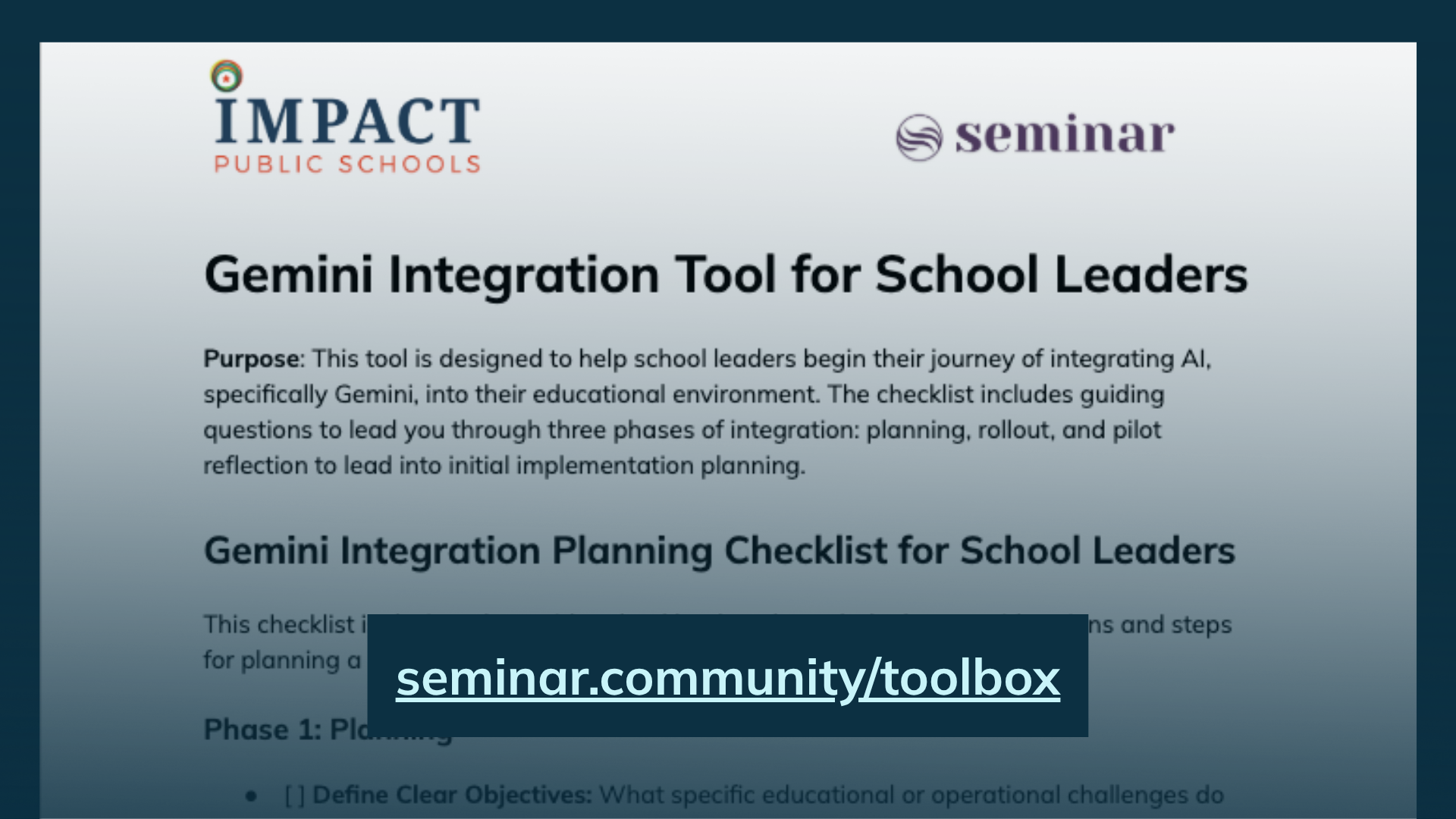
Gemini Integration Tool for School Leaders, accessible via Seminar Core
We treated our rollout as a series of thoughtful phases, not a one-and-done announcement:
Planning Phase:
- Defined goals and safeguards to protect student data
- Formed steering committee and decision frameworks
Rollout Phase:
- Invited early adopters to experiment
- Offered optional training on best practices
- Encouraged real challenges, not hypotheticals
- Set clear boundaries (e.g., no student names) while encouraging creativity
Learning Phase (where we are now):
- Collecting effective use cases
- Exploring usage data in Google Workspace
- Considering expanding the steering committee
We developed a Gemini Integration Checklist for school leaders that breaks this into manageable phases. We’ve added this in the Seminar Toolbox, which is accessible via Seminar Core
What’s Working So Far — and What’s Coming Next
Our goal was reducing workload and increasing clarity:
- Coaches input observation notes and get rubric-aligned feedback language automatically
- Ops teams optimize transportation routes and streamline communications
- Talent teams generate job descriptions and interview questions faster
- Finance teams enhance budgeting and identify anomalies
The most consistent feedback? "I didn't know this was possible."
That's why sharing examples has been critical. Usage increases when people see specific use cases, not abstract possibilities.
We're expanding to more employees, especially teachers who've shown interest. We're also exploring paid features for additional capabilities.
For us, integrating AI is about securing our future and strengthening our mission. As educators, we have a responsibility to model thoughtful tech adoption while protecting the students and families we serve.
What I Hope You’ll Carry With You
We're still early in this journey at Impact Public Schools, but I'm confident we made the right choice to start now, start small, and start strategically. Our teachers are spending less time on administrative tasks and more time building relationships with students. Our operations are more efficient. Our decision-making is more data-informed.
Most importantly, we're modeling for our students what thoughtful innovation looks like — how to embrace new tools while staying grounded in human values.
The future is coming whether we're ready or not. The question isn't whether AI will transform education, but whether we'll shape that transformation or let it shape us.
About the Authors
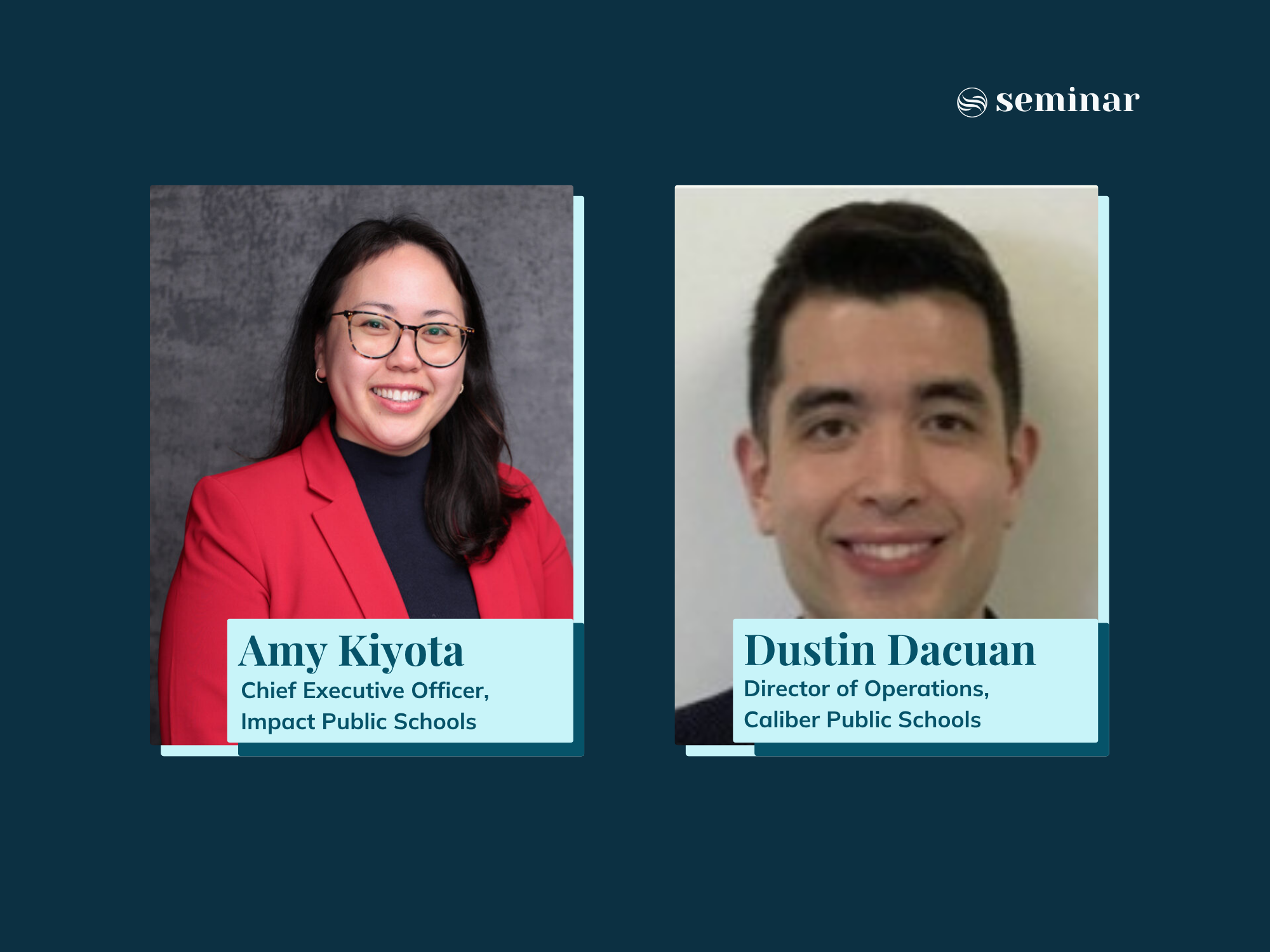
Amy Kiyota is the CEO of Impact Public Schools located in the Puget Sound region of Washington state which includes four high-performing charter elementary schools.. Amy most recently served as the Co-CEO and led all internal workstreams and strategies. Prior to this, Amy was Chief of Staff of Impact Public Schools supporting strategic initiatives, fundraising, facilities, and cross-functional management. Amy has also served as the Senior Director of Operations focused on operational excellence across all IPS schools.
Dustin Dacuan is the Director of Operations at Impact Public Schools, where he leads system-wide strategy for key operational areas including technology, attendance, and professional development for Operations team members across a growing network of charter schools.
This article is an excerpt from one of Seminar’s expert-led workshops, designed to provide actionable insights on key topics for charter school teams. Each session includes practical templates and strategies to help your team thrive. Seminar workshops and all tools mentioned in this post are available in the Seminar Toolbox, which is accessible via Seminar Core.