
The Facility Trap: What Too Many School Leaders Learn the Hard Way
A few days into my role as the COO of a charter school network, I got a call that would change how I think about facilities forever. A developer, clearly agitated, was on the other end of the line with choice words to share about a $3 million funding gap one of our schools was on the hook for. After threatening to sue everyone involved, he hung up. I sat there thinking: "I better figure out how to get this thing done."
That moment led me down an unexpected path as a former history teacher turned finance and operations leader. Over the next decade, I'd work on dozens of facilities projects and help originate over $1 billion in charter school facility loans. These experiences inspired me to develop the FRED Framework – a nine-step process that can help any charter school leader navigate the complex world of facilities development.
Let me be direct: securing an affordable, program-aligned facility is often the greatest impediment to a charter school's ability to grow sustainably and produce excellent results for students. I've seen it firsthand; schools that nail their academic program but struggle with the facilities process – or, worse yet, end up in a building they can’t afford – endure knock-on effects that impact everything from budgets to enrollment to school culture.
The FRED Framework
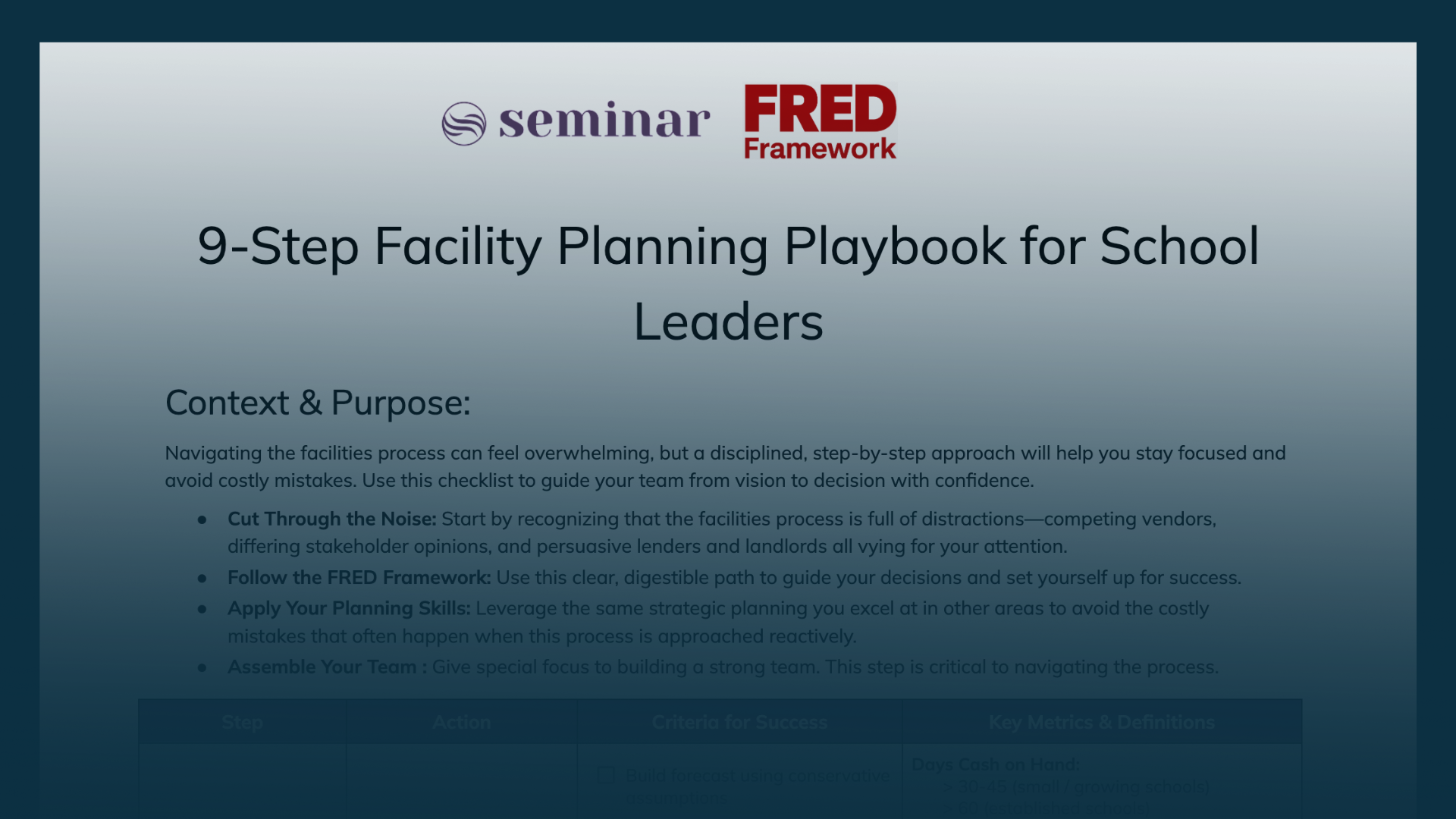
9-Step FRED Framework in the Seminar Toolbox
The FRED Framework is deliberately simple: nine steps that, if followed with fidelity, create better facilities outcomes. Think of it as bringing the same systematic approach you use for curriculum planning or strategic enrollment growth to your facilities process.
What is it? A simple yet highly-practical 9-step framework to increase facilities success.
Why does it exist? There's too much noise, too little time, and too many opportunities for costly mistakes in the facilities world.
How will it help? By using the framework to plan ahead and track your progress, you'll avoid potential costly and time-consuming mistakes down the road.
The nine steps are:
- Know Your Projections - Develop baseline financial forecasts with conservative assumptions
- Know Your Project - Define space, location, and program alignment needs
- Know Your Process - Identify which steps will be most challenging
- Assemble Your Team - Cover blind spots with the right expertise
- Find Your Site - Locate options that meet your criteria
- Fund Your Project - Secure necessary debt and grant sources
- Build Your Project - Execute construction or renovation
- Enjoy Your New Home - Celebrate and engage stakeholders
- Maintain Compliance - Keep up with ongoing requirements
If you get steps 1-4 right, steps 5-9 become much more manageable.
Let me share how this played out in real scenarios. That project I mentioned? Things could’ve been tighter on the front end. The baseline forecast would have benefitted from more conservative assumptions and clear alignment with key lender metrics. We had yet to develop a comprehensive fundraising plan. More time spent on site selection might have enabled a project with less execution risk. All of the above led to long days and sleepless nights spent patching together the funding we needed to make things work.
Contrast that with a recent project I worked on in my capacity as a charter school board member. Prior to launching, the school had a developer pull out of a project that was supposed to deliver their long-term home, leaving them in less-than-ideal temporary space in year 1. When I joined the board, we applied all nine steps of the FRED Framework systematically, starting with a solid forecast model and reasonable fundraising goals (Step 1) as well as alignment on facility “must haves” vs. “nice to haves” (Step 2). We identified our blind spots early and assembled the right team to address them, including a local owner’s rep (Steps 3 and 4).The leaders had already built strong community connections that proved invaluable for site sourcing (Step 5), and five different lenders expressed interest in funding the project (Step 6).
The result? The project came in on time and on budget, and at the beginning of last school year, the school moved into its permanent middle school facility – a great space right in the heart of Jersey City that serves about 200 students. We had a proper ribbon cutting ceremony to celebrate with the community.
The Power of Team
If I had to pick the most important step in the framework, it would be Step 4: Assemble Your Team. Get the right people involved at the right time, positioned to cover your blind spots, and you'll save yourself headaches and money throughout the rest of the process.
During a Seminar workshop, one participant captured it like this: "We stumbled right out of the gate with step one. We just didn’t build the right team and were asking people to take on things they weren’t prepared for." Another shared how having the right consultant to navigate lender due diligence processes – even when they typically handle everything in-house – made all the difference in their current project.
The reality is that charter school leaders are excellent at many things – some of which are absolutely critical to student outcomes and more challenging than the facilities process – but real estate often requires specialized expertise. Whether it's structured finance, construction management, or navigating local politics, you need people who've done this before and can help you avoid the costly mistakes that derail projects.
Real-World Challenges
During our workshop discussion, several common challenges emerged:
Costs, Location, and Enrollment: One network in California highlighted how real estate costs become "stupid expensive" when you factor in seismic building codes and other regulations. Rising costs put additional pressure on the already-real tension between finding the right location and maintaining viable enrollment projections, especially in areas experiencing declining enrollment.
Community Partnerships: Multiple participants emphasized that building relationships with local electeds and community members isn't just nice to have – it's essential for finding sites and navigating zoning and planning approvals. As one leader noted, "If you're going into a new community, you need champions, and building those relationships takes time."
Transportation Barriers: The challenge of balancing optimal location with accessibility came up repeatedly. One participant described finding a great site that's just outside their ideal service area, creating transportation challenges that impact both enrollment and mission alignment.
Making It Practical
The beauty of the FRED Framework is its simplicity. You can use it as a high-level project tracker, noting where you are with each step and identifying gaps that need attention.
However, it is most effectively used as a planning tool, one that allows you to pre-identify obstacles in order to make your facilities process run more smoothly. Obstacles are best addressed by planning what I call "DOPE actions" - actions that are Doable, Ownable (by specific people), Priority-focused, and Excellence-inducing.
For most leaders, success comes down to three key actions that collectively constitute Step 3 (Know Your Process) and Step 4 (Assemble Your Team) of the Framework:
- Review your internal team's capabilities - Be honest about what you can and can't handle
- Identify your blind spots - Where do you need outside expertise?
- Build your external team - Find mission-aligned professionals who have done quality work for other schools
I created a comprehensive 9-Step Facility Planning Playbook for School Leaders Toolkit that breaks down each step with detailed guidance, key metrics to track, and vetted resources to help you succeed. You can grab it from the Seminar Toolbox and start applying it to your next facilities project immediately.
Looking Forward
Facilities work doesn't have to be the constant crisis that many school leaders experience. When you plan ahead and break down the process into tactical steps, you can avoid the time-consuming and costly mistakes that derail projects.
The charter school community has incredible resources and expertise available. The key is knowing when to ask for help and building the right team to support your vision. Whether you're planning your first facility or your fifth, having a systematic approach makes all the difference.
Also, please remember to celebrate your facilities victories. Too often, we're so focused on the next challenge that we forget to acknowledge the tremendous achievement of creating a highly-functional space where students can thrive (without breaking the budget!). Plan that ribbon cutting ceremony. Invite the community. Enjoy your new home.
Your students deserve nothing less than a facility that supports their success, and with the right approach, you can deliver exactly that.
About the Author
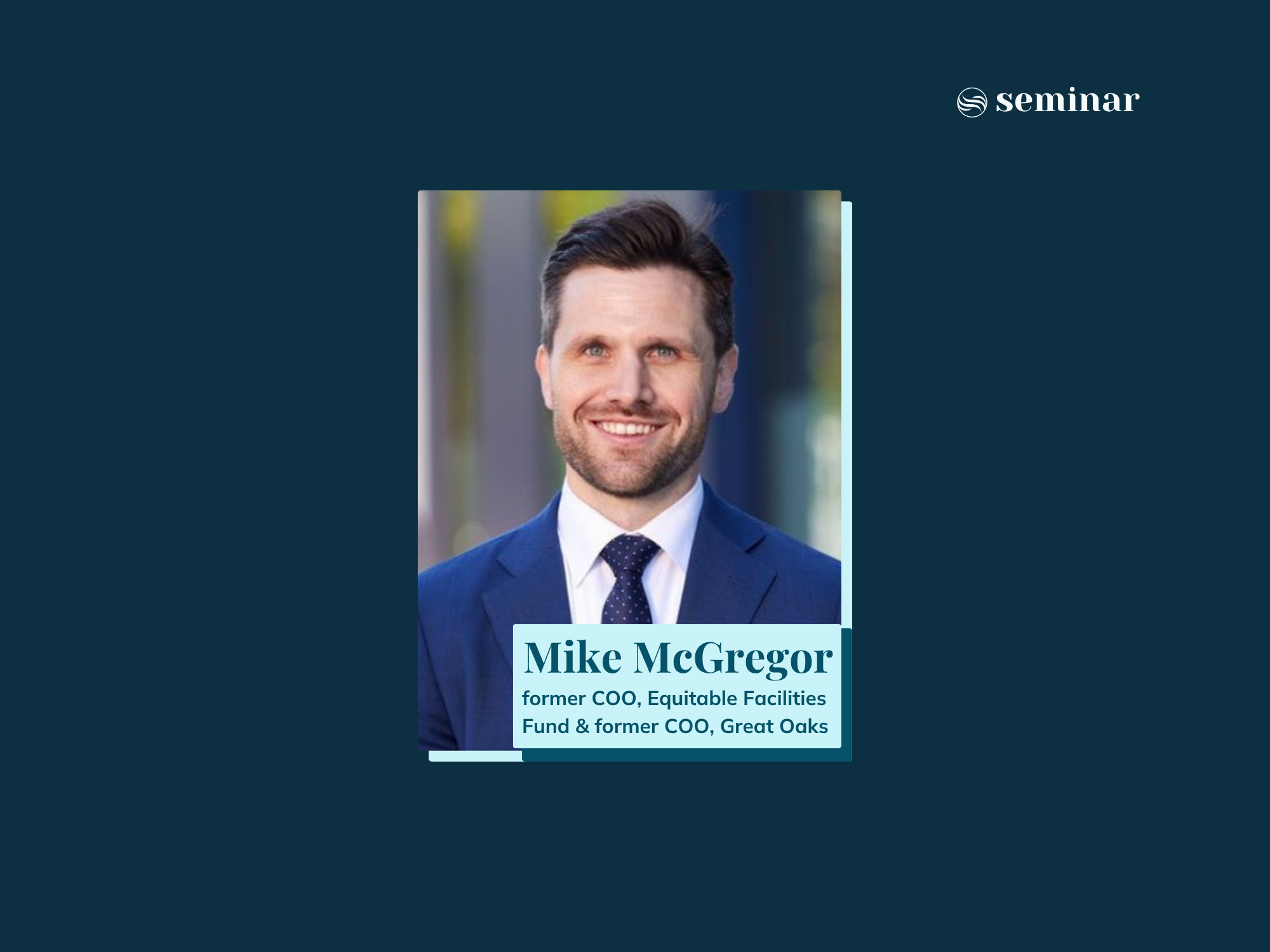
Mike McGregor is a mission-driven finance and facilities expert serving as senior advisor for FRED, an initiative eliminating facilities barriers for charter schools. He is the founder and Managing Partner of Children First Capital Advisors, where his team builds finance, strategy, and municipal advisory solutions for organizations seeking to expand their impact , and of Mila Realty Group, a community-focused real estate firm. Previously, Mike was COO at Equitable Facilities Fund, where he supported over $1.3B in charter school investments, and held senior leadership roles at the Great Oaks Foundation and Match Charter School. He holds an MBA from Columbia and a BA from the University of Pennsylvania, and is a founding trustee of Kindle Education Public Charter School.
This article is an excerpt from one of Seminar’s expert-led workshops, designed to provide actionable insights on key topics for charter school teams. Each session includes practical templates and strategies to help your team thrive. Seminar workshops and all tools mentioned in this post are available in the Seminar Toolbox, which is accessible via Seminar Core.