
The Priorities Jar: Make Space for Your “Big Rocks” — Work Only You Can Do
When we envision the shifts, initiatives, and new possibilities our team will embrace next year, that list likely feels substantial, and your approach to these opportunities probably reflects one of these mindsets:
- "I need to solve everything now" (urgency makes it difficult to choose where to focus)
- "Doing more equals leading well" (assuming visibility equals impact)
- "Everything feels important" (you haven't paused to prioritize strategically)
- "If I own it, I must do it" (feeling compelled to lead every initiative personally)
Recently, I sat with a principal who was energized about his upcoming year. As we explored his weekly academic team meetings and curriculum development opportunities, I asked him a question that sparked a breakthrough: "Do you have to do that?" After a thoughtful pause, he said something that resonated deeply: "I don’t have to do it, someone else can but I'm afraid of my own workstreams. I’d much rather solve the things I know how to solve.."
That candor was both refreshing and relatable. We naturally gravitate toward work we know how to do – familiar tasks that feel manageable and provide a sense of accomplishment, while the work that could truly transform our schools waits patiently in the background. And when we finally engage with it, that's where the magic happens.
The Big Rocks Framework
This concept builds on Stephen Covey's time management principles but applies them specifically to educational leadership. The core idea is simple yet powerful: Picture your time as a jar. You have three categories of work competing for space in that jar, and the order in which you place them determines what fits.
When you fill your jar first with sand (small tasks) and pebbles (medium tasks), there's no room for the big rocks – those transformational initiatives that actually move your school forward. But when you intentionally place the big rocks first, everything else finds its proper place around them.
Here's how to think about the three categories of work in your leadership jar:
Big Rocks (1-3 maximum): Strategic priorities tied to organizational goals that require your leadership energy to shift behavior, results, or direction. These should lead to visible progress and create lasting organizational change.
Pebbles: Daily operations and ongoing responsibilities that keep things running smoothly but don't drive transformation. These maintain momentum and preserve the status quo without reshaping your school's trajectory.
Sand: Routine administrative tasks (e.g., email responses, routine approvals, and operational maintenance) that keep the lights on but don't move you forward strategically.
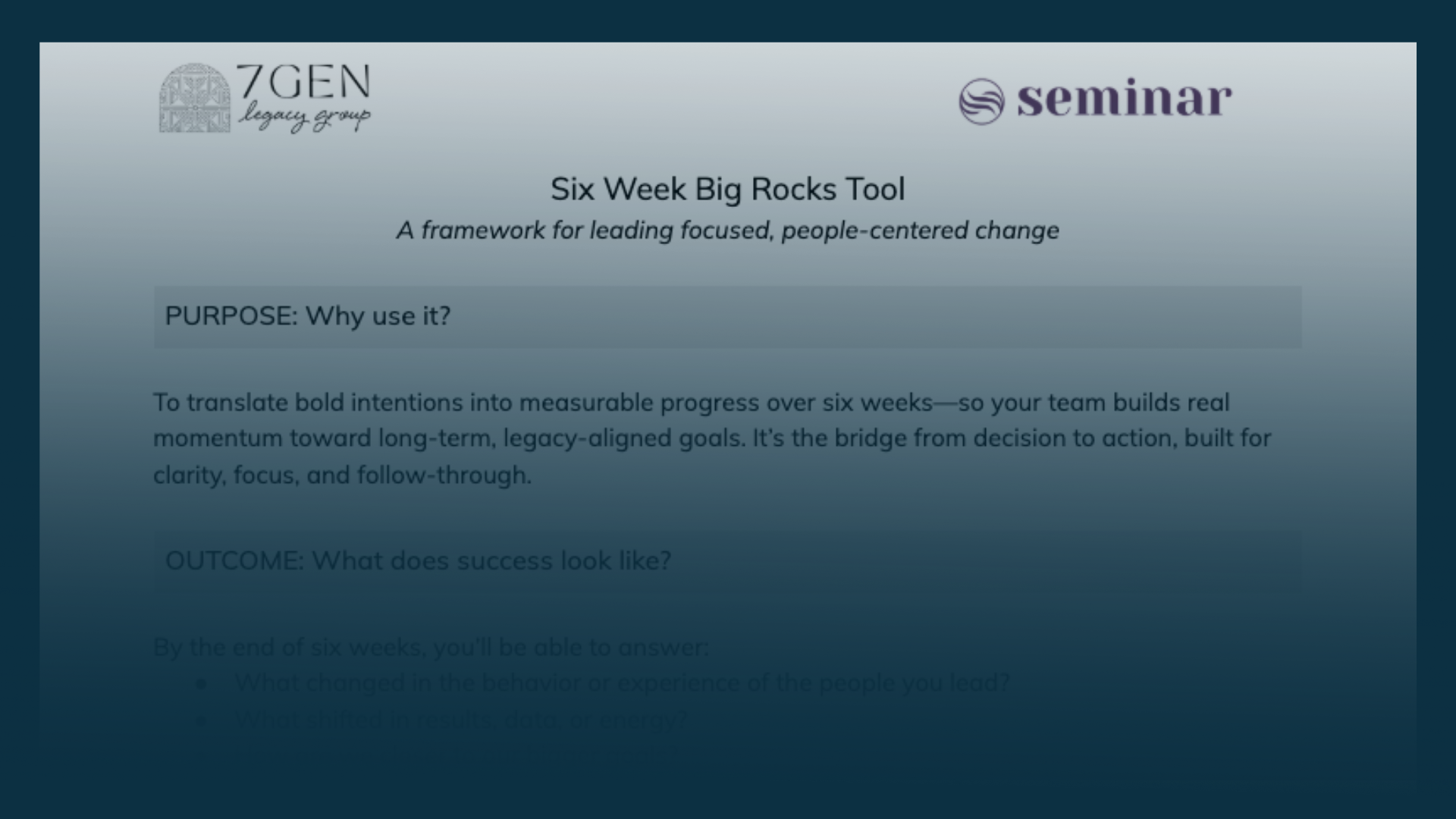
The key insight is this: you need all three categories, and when you're intentional about which receives your primary leadership energy, you create the conditions for results. The question becomes: how do you translate this framework into the day-to-day reality of school leadership? I've included an Effective Change Management Using Big Rocks Tool in the Seminar Toolbox to help you and your team transform bold intentions into measurable progress over six weeks.
How This Benefits Your School and Organization
Our calendar is a moral document. When we shape our work around the changes we need to make within our organizations, we maximize our most important opportunity to serve students and staff.
When you start categorizing where you spend your time, you'll begin to realize places where you can trust others and establish clear boundaries around your role. This clarity becomes liberation – for you and your team. When you develop the confidence to delegate tasks that are important but less critical than your big rocks, you're actually developing deeper leadership capacity throughout your organization.
Remember this fundamental truth: Too many big rocks equals no big rocks. This means making hard choices about what you won't pursue, even when those initiatives seem valuable. Big rocks build the future. Pebbles and sand keep operations steady. You need both, but when you're strategic about which receives your focused energy, you create the conditions for real transformation.
Making It Sustainable and Energizing in Your School Context
A leader at a Seminar workshop asked about adapting this framework to energize different experience levels on her team. My response: approach this like any other skill you'd systematically develop in your school – with intention, support, and celebration.
You'll know the framework has truly taken hold when people are walking down hallways saying, "My big rock is..." with genuine excitement about their focus. To achieve this cultural transformation:
- Assess where people are in their change leadership skills and celebrate their current strengths
- Provide professional development on the Big Rock framework
- Create opportunities for practice and refinement where people can experiment and grow
- Integrate it into your existing coaching and feedback cycles to make it a natural part of your leadership development
Resist the urge to take this tool and have it replace everything you're already doing well. If you have nine-week cycles that work effectively, adapt the framework and the key teachings to fit your existing structure. The key is making shifts intentional and strategically timed within your organization's habits
Your Action Plan for the Upcoming School Year
As you prepare for the upcoming school year, this systematic approach will set you up for success:
Step 1: Audit your current list of shifts, initiatives, and new expectations. Be honest about the length of that list.
Step 2: Categorize everything into rocks, pebbles, and sand. Limit yourself to 1-3 big rocks maximum.
Step 3: If you identify multiple big rocks, prioritize them by asking: "What's the one thing that, when it changes, will unlock the most progress for our team and organization?"
Step 4: Build your six-week (or nine if your cycles are longer) implementation plan around your top priority, ensuring it's focused (clear scope), people-centered (involves the right stakeholders), and measurable (has concrete success indicators).
Step 5: Once you've tested the framework yourself, begin teaching it to your team so everyone speaks the same language about priorities and strategic focus.
The Leadership Opportunity
The most effective thing you can do as a leader is achieve clarity about what deserves your energy and time – and what deserves your team's energy and time. Your students are counting on you to do the work that only you can do.
When you focus on your big rocks, you're not just managing your time more effectively, you're modeling strategic thinking, demonstrating how to prioritize for impact, and creating the conditions for sustainable organizational transformation
About the Author
Shawna Wells is the founder and CEO of 7Gen Legacy Group, a leadership development firm that trains, coaches and builds systems for legacy-minded leaders.Throughout her career, Shawna has worked with hundreds of executive leaders across the country to build management systems that honor and implement generational health.
A legacy-architect, Shawna has created a new blueprint for leaders to live and leave their legacy. She leads and lives with her legacy at the center serving on the board of several organizations working to impact the lives of the next 7 generations including The Highland Project, Teach for America Las Vegas, and The University of Vermont College of Education and Social Services.
This article is an excerpt from one of Seminar’s expert-led workshops, designed to provide actionable insights on key topics for charter school teams. Each session includes practical templates and strategies to help your team thrive. Seminar workshops and all tools mentioned in this post are available in the Seminar Toolbox, which is accessible via Seminar Core.