
Celebrating Innovation: The 2025 Seminar Leadership Awards
Each year, education leaders across the country dedicate themselves to work that transforms schools, strengthens communities, and expands opportunity for students. To honor the spirit of that work, Seminar launched the inaugural Seminar Leadership Awards, created to recognize leaders whose influence reaches far beyond their own organizations.
These awards highlight leaders who innovate boldly, strengthen communities, and elevate the field through courage, clarity, and connection.
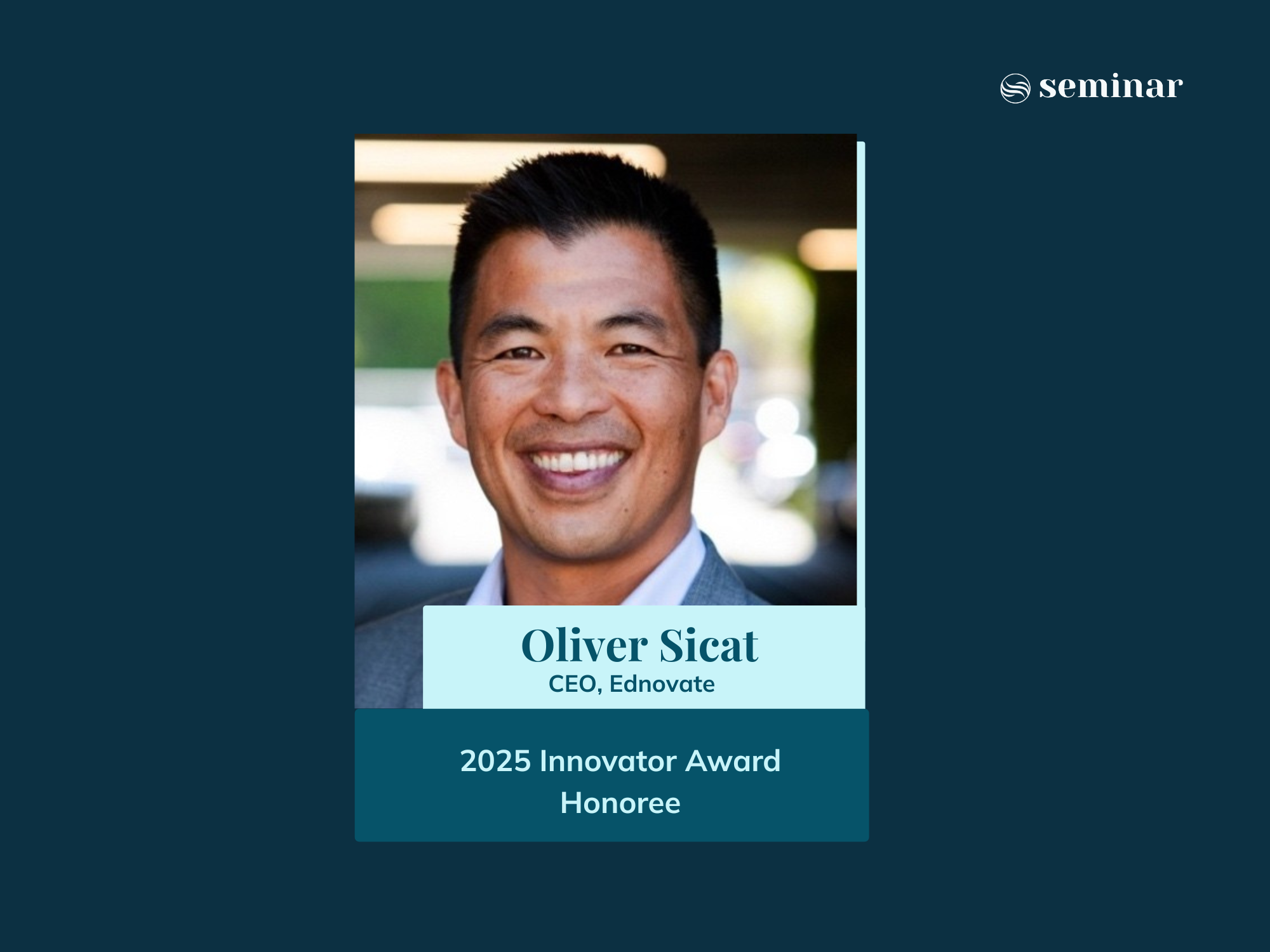
In this inaugural year, Seminar is proud to recognize our Innovator Award Honoree, recognized for his visionary use of technology and AI to expand equity, reimagine learning, and solve persistent challenges in education.
The Innovator Award

Honoring Oliver Sicat, CEO, Ednovate
The Innovator Award celebrates an education leader who leverages artificial intelligence or emerging technologies to reimagine the learning experience, increase equity, or solve persistent challenges in education.
Oliver Sicat, CEO of Ednovate, has long been at the forefront of rethinking what’s possible in schools. Under his leadership, Ednovate has embraced innovation not as a novelty, but as a pathway to deeper connection and equity. From integrating AI to support personalized learning to exploring new ways to engage students in real-world problem solving, Sicat’s work exemplifies what it means to harness technology in service of humanity.
“AI isn’t replacing our work; it’s strengthening it. It’s helping us build a more responsive, more personalized, and more joyful school experience for kids.”
- Oliver Sicat
In Conversation with the 2025 Honoree
We caught up with Oliver Sicat to learn more about what drives his leadership, how he approaches innovation and impact, and what gives him hope for the future of education.
Oliver Sicat | The Innovator Award
Q: What does receiving the Innovator Award mean to you?
A: “Receiving the Innovator Award is meaningful because it reflects the collective work of our team. Innovation at Ednovate is truly a shared effort; our staff shows up every day believing we can create a better school experience for students and that when we learn something that works, we share it with anyone aligned with our mission. One person can’t do this alone, and I’m proud to be part of a team that embodies that spirit so fully.
It also connects us to a long and proud tradition in the charter school sector: being the innovation hub for public education and openly sharing best practices because our bottom line is student impact. When I first joined this work, the innovators of that time were incredibly generous with what they had built. Their openness shaped me, and it continues to guide how we contribute to the field today.
So this award is truly an honor, both for what it recognizes in our team and for the tradition we’re carrying forward.”
Q: How are you currently leveraging AI or emerging technologies in your work?
A: “At Ednovate, innovation is literally in our name, so we feel a responsibility to live up to it :) A simple mission has always driven us: to deliver phenomenal student outcomes and the best possible student experience, fostering positive multigenerational change. Technology has been an essential enabler of that vision for years, and AI is helping us take the next step.
We’re taking a very intentional and systematic approach. First, we’re cleaning up and protecting our data so it can be used safely and at scale. Then we’re mapping the key functions that drive academic outcomes, enrollment, and operational efficiency. Each year and each quarter, we focus on the highest-leverage parts of that map to make meaningful gains.
Right now, we’re using AI to support daily grade-level instruction, provide more frequent and higher-quality informal assessments, and accelerate teacher growth. And we’re using it on the operational side as well, helping teams work more efficiently so they can spend more time focused on students.
AI isn’t replacing our work; it’s strengthening it. It’s helping us build a more responsive, more personalized, and more joyful school experience for kids.”
Q: How do you balance innovation with equity and human connection?
A: “At Ednovate, equity has always been the starting point. For the last five to ten years, we’ve built dashboards that quickly surface whether any of our policies or practices are creating inequities across our organization. When something shows up in the data, our first question is, “Can AI help — and if so, how?”
That mindset has led to real progress. We’ve used AI to strengthen lesson planning, better serve students with special needs, and support students learning English as a second language. In each case, the goal is the same: remove barriers so every student can show what they know.
We believe deeply that every student has genius within them. Our job is to find the tools and practices that help them shine. When technology helps us do that, when it elevates student voice, expands access, and strengthens human connection, then it’s serving equity in the way it should.”
Q: What advice would you offer to other education leaders exploring technology’s role in learning?
A: “One innovation I’m especially proud of this year is our year-long study using third-party i-Ready and STAR data on the impact of one-on-one AI tutors like Khanmigo and others. We’ve seen clear gains for a subset of students across our schools, students with different learning profiles who benefited from consistent, personalized support with very little adult intervention. It’s been powerful to see how an AI tutor, used thoughtfully, can accelerate growth.
I’m also incredibly proud of our AI Working Group, led by Lanira Murphy and Kevin Nham. Their leadership, and the staff who partnered with them, helped us understand not just the effectiveness of tools like Khanmigo and others, but how to roll them out responsibly and systematically. This year’s work moved us another big step toward using AI in ways that ultimately drive phenomenal student outcomes.
Lots of other things as well but these rise to the top.”
Q: Innovation often requires courage and iteration. Can you share a moment when you took a risk that paid off — or taught you something valuable?
A: "The most significant risk we took was deciding to kick off this entire AI initiative in the 23–24 school year. It wasn’t part of our strategic plan even 12 months earlier, but we could see the pace of change coming fast, and we knew we needed to set the conditions early if we wanted to learn responsibly and stay ahead for our students.
We moved quickly, creating parameters, forming working groups, clarifying our “why,” and building guidelines that could evolve as we learned. It was a big shift for the organization, and any time you move at that speed, you’re stepping into uncertainty.
What I learned was powerful: when we ground the work in student outcomes and equity, explain the “why” clearly, and create safe spaces for people to play, test, and fail forward, our staff rises to the challenge. They want to do what’s best for kids; they need to know it’s okay to try.
The result has been incredible alignment across our schools. Our teams are using these rapidly developing tools in thoughtful, mission-driven ways, all pointing toward our long-term goals. And while nothing is perfect, we openly acknowledge that we’ve built a learning culture around innovation. That culture is the real win.”
Q: What advice would you offer to other education leaders exploring AI and emerging tools in their schools?
A: “Some of the best advice I received early on is the same advice I’d offer to other leaders today.
First, start with your data. Know what you have, clean it, organize it, and get clear about what’s actually valuable. Setting up strong data foundations now prepares you for long-term use of future AI tools and prevents a lot of headaches later.
Second, process-map five to seven key workflows that drive your student outcomes, your operational costs, or both. When you can see those processes clearly, it becomes much easier to pinpoint where AI could make them faster, more accurate, or more responsive.
From there, experiment. Try existing tools and see where they fit. If the tools you want don’t exist yet, start building simple ones that work for your context. You don’t need something perfect, you need something practical.
The leadership team must learn alongside the organization. None of us is a true expert yet, so building that fluency together matters. Form an innovation or AI working group that can systematically pilot, test, and scale what works and, just as importantly, quickly discard what doesn’t. That rhythm keeps you focused on what actually benefits students.
And finally, stay curious. This space is changing fast, and the joy comes from the small breakthroughs, the moments when a tool helps a teacher, unlocks a student, or strengthens a workflow. If you keep learning and stay grounded in student impact, you’ll find your way.”
Q: Looking ahead, what gives you hope about how technology can transform education for the better?
A: “What gives me hope is seeing how the leading-edge innovators in our field are using AI, not just to improve academic outcomes, but to create a richer, more human experience for students. Yes, students are learning their traditional coursework more effectively, but they’re also gaining so much more.
I’m seeing schools use AI to create time for students to develop emotional intelligence, learning about themselves and others, and how to listen and respond with care. I’m seeing schools use it to free up space for purpose and passion work, the kind of learning we prioritize at Ednovate when students tackle real-world problems, build ventures, and discover what they’re capable of.
I’ve watched students who traditionally struggled to access content finally receive learning tailored to their needs, and with that personalization, their confidence grows. When used responsibly and for good, AI can be a powerful equalizer. It can help every student access what they need, discover their hidden genius more quickly, and step into their potential in ways that change their lives and our world.
That’s what gives me hope.”
Looking Ahead
The Seminar Leadership Awards illuminate the bold ideas and unwavering commitment that continue to move our sector forward. As we honor Oliver Sicat, our 2025 Innovator Award recipient, we celebrate the spirit of possibility he embodies — a belief that technology, when grounded in equity and purpose, can expand opportunity for every student.
Oliver’s work reminds us that innovation isn’t just about new tools. It’s about cultivating the mindsets, systems, and learning environments that help young people thrive today and prepare for tomorrow. His leadership challenges all of us to stay curious, stay courageous, and stay focused on what matters most.
“Leaders like Oliver show what’s possible when vision and discipline meet a deep commitment to students. His work pushes the field forward in ways that are both practical and profound.”
- Kristen McCaw, Seminar’s Co-Founder & Co-CEO
Congratulations to our 2025 honorees — and to every leader working to shape the future of education.
To read about our other honoree, check out Todd Dickson’s recently published feature on the Collective Genius Award.
Learn More
To learn more about the Seminar Leadership Awards, including details about our honorees and judging process, click here.
Ready to deepen your leadership journey? Join the Seminar community here.