
Turn the new federal tax credit into real relief for your families.
Starting January 1, 2027, donors can cut their federal taxes by up to $1,700 per person when they give to K-12 scholarships. A married couple can reach $3,400 when each spouse gives $1,700.
A part-time EFTC Project Lead for your school. Your lead guides your team from choosing an SGO (your scholarship partner) and defining what scholarships cover to a ready-to-launch scholarship plan and campaign, then keeps it on track as federal and state rules change. We do as much of the work as possible, and you make the decisions.
Last reviewed October 31, 2026. Federal rules are proposed, not final, and states are still opting in.
The extras your families pay for today could be covered.
The Education Freedom Tax Credit (EFTC) funds scholarships through nonprofit Scholarship Granting Organizations (SGOs). Students can qualify if they are eligible to attend public school and their household income is at or below 300% of the area median. Scholarships can cover costs like fees, books, supplies, uniforms, transportation, and technology.
For public schools, that can mean the field trips, after-school programs, devices, and extras families pay for today become covered. It can also mean budget relief for your school.
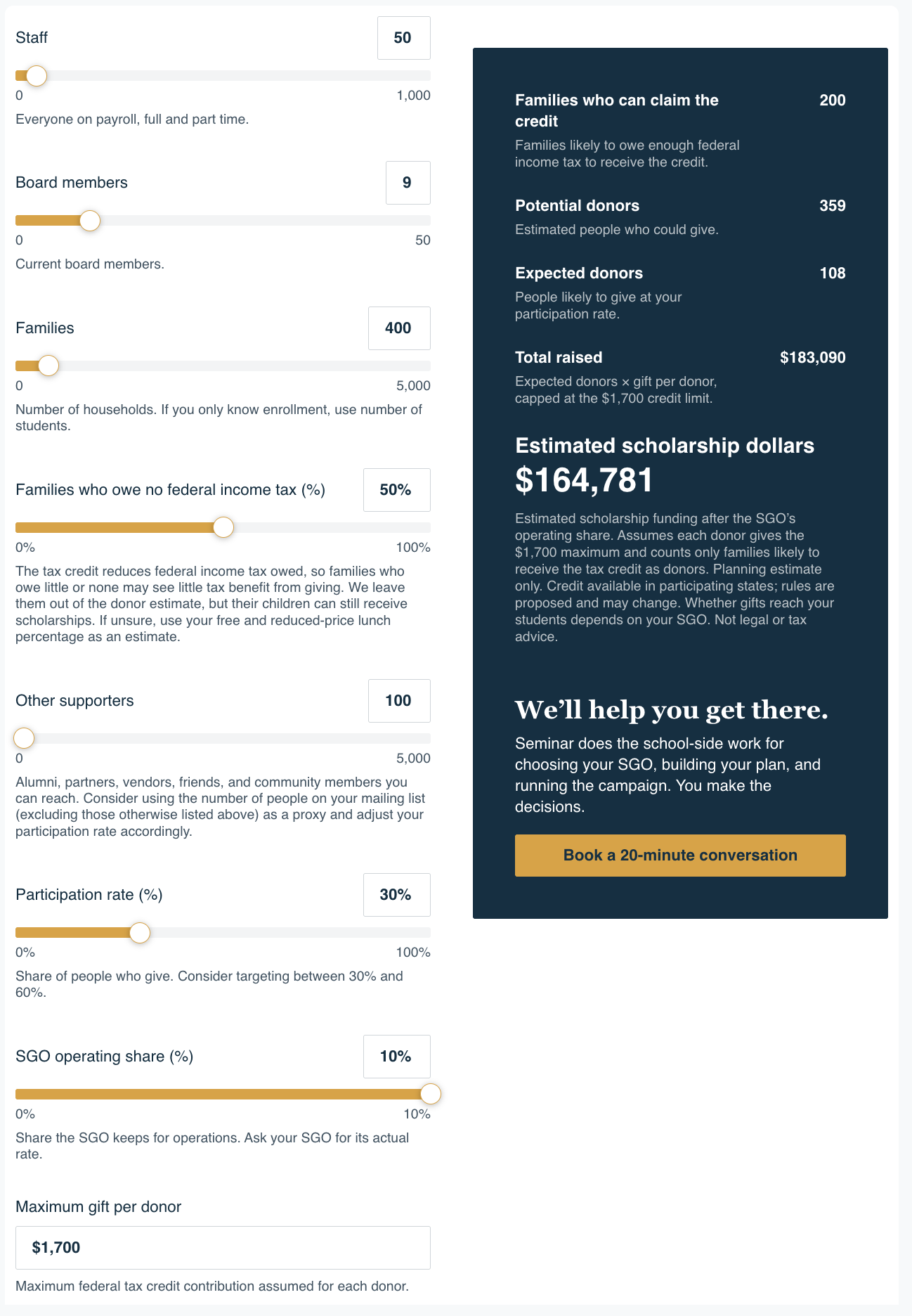
EFTC Estimator: See how much your school could raise
The opportunity is real, and so is the work.
Treasury and the IRS proposed the rules on October 1, 2026, and they are still being finalized. States are still opting in. Your team needs to pick an SGO, sort out what is scholarship-eligible in your state, build a donor base, and set up tracking for your accounting team. All of it lands on leaders who are already at capacity.
We do as much of the work as possible. You make the decisions.
- 1
Choose the right SGO
We brief your leaders, research your state's rules, draft evaluation criteria with you, interview approved local and national SGOs, and deliver a recommendation your CEO and board can act on.
- 2
Build your scholarship plan and campaign
We inventory your family fees, define the scholarship bundle, model the family view, set fundraising goals, design a voluntary payroll-deduction option, and design a friends and family campaign with ready-to-use templates for families and staff.
- 3
Keep it on track
We track milestones, donors, and dollars raised, hold monthly check-ins, report scholarship revenue and uses, and update your plan as federal and state rules change.
You keep control of what matters.
Your CEO and senior team make the decisions and final approvals. You share fee schedules and budget data, and your accounting team handles day-to-day tracking with templates we provide. Legal, payroll, and tax review stay with your advisors. Seminar does not provide legal or tax advice.
Built by school leaders, for school leaders.
Seminar serves nearly 5,000 K-12 leaders across 45 states. Our founders have launched and led public schools, so we know what it takes to add something new without adding to your team's load.
Frequently asked questions
What is the Education Freedom Tax Credit?
A new federal tax credit, officially the Federal Scholarship Tax Credit (Section 25F). Starting in 2027, donors can claim a dollar-for-dollar credit of up to $1,700 per person for cash gifts to approved SGOs. Spouses filing jointly count separately, so a couple reaches $3,400 only when each gives $1,700. The credit is nonrefundable: it lowers the tax a donor owes but doesn't create a refund.
Does it stack with state credits or a charitable deduction?
The federal credit is reduced by any state tax credit claimed for the same gift, and donors can't also take a charitable deduction for it. Donors should confirm their situation with a tax advisor.
Is my state participating?
States must opt in. The IRS keeps the current list on its Federal Scholarship Tax Credit page. We confirm your state's status at kickoff.
Can any public school benefit?
Yes. Eligibility is based on a student being eligible to enroll in public school and on household income, not on the type of school. What a scholarship can cover depends on your state's rules, which is the first thing we research.
Who can donate?
Individual taxpayers, including your staff, families, board, partners, and community. Donors can give to an approved SGO in a participating state no matter where they live.
How much could my school raise?
Join Seminar free to use our EFTC Estimator to see a range based on your staff, community, and fees.
What does it cost?
Tell us about your school and we'll scope it with you.