
Making Your Board Work: How to Turn Governance Into Your Competitive Advantage

When I first started building Rocky Mountain Prep, I knew we needed a board. What I didn't understand was how transformational the right board could be for our success—or how devastating the wrong approach could be for our time and energy.
After years of building, leading, and restructuring boards across multiple schools, I've learned that most education leaders are sitting on a goldmine they don't know how to access. Your board can either be your secret weapon for accelerating student outcomes and organizational growth, or it can be a monthly energy drain that pulls you away from what matters most.
The difference comes down to how you think about governance.
What Your Board Should Actually Be Doing
Let's start with the fundamentals. A strong board serves six core responsibilities:
- Keeper of the vision and strategy – not the day-to-day tactics
- CEO oversight and development – this is their most powerful and important role
- Board self-management – they govern themselves effectively
- Provide resources – to support your vision and strategy
- Remove obstacles – before they become crises
- Risk management – to ensure long-term sustainability
Notice what's missing? They don't manage the curriculum. They don't hire teachers. They don't decide which reading program to buy. When boards drift into operational details, everyone loses.
The Cool Kids Table Theory of Board Building
Early in my journey, I met with an education veteran who gave me advice that changed everything. He said, "James, remember back to middle school—there was a cool kids table and a not-cool kids table. Building a good board is basically the same thing. You want to get people on your board that other strong, effective, capable people want to be around and learn from."
This might sound harsh, but it's true. A-players want to work with other A-players, and the same applies to board service. If you start with strong people at the core of your board, they'll attract other strong people. If you settle for whoever is willing to serve, you'll get a board that reflects that standard.
The uncomfortable truth? Building a great board starts with you as the CEO taking full ownership of the outcome.
You Either Run the Board, or the Board Runs You
Here's what I wish someone had told me early on: all the good things and bad things about your board are the CEO's responsibility. As Deloitte’s Seven Steps to a More Strategic Board puts it, "It all starts with the CEO: in determining his or her openness, determining what the board wants, and articulating what the board members need to do."
If your board isn't functioning well, if they're spending time on the wrong things, if meetings feel like a slog—that's on you.
You have two choices: you can run the board as the CEO and senior leadership team, or the board is going to run you. They'll set the agenda, talk about what they want to talk about, and probably not add the value you need.
This doesn't mean being dictatorial. It means being intentional about structure, preparation, and focus. It means having the courage to redirect conversations when they drift into the weeds. It means setting up systems that channel your board's energy toward high-impact strategic questions.
Remember: your board wants you to succeed. They have no reason not to want you to be the most successful CEO in your field. When you take ownership of governance, you're giving them the structure to help make that happen.
The Power of a Strong Board Chair Partnership
One of my most important relationships was with Pat, our board chair. Every week for years, I would drive out of my way to meet him at a coffee shop at 7 AM before school started. We'd talk through everything: the strategic challenges, the operational fires, the vision for where we were heading.
This wasn't just nice relationship building. When crises hit (and they always do in education), I had a partner who understood the context, knew the players, and could help me think through solutions. When we had a staff member arrested over the weekend, when teachers had personal emergencies that affected our tiny team, when we faced regulatory challenges—Pat was already up to speed and ready to help.
A good chair and CEO working together set the agenda. The chair should be meeting with other board members regularly. Together, you're creating alignment on governance priorities and ensuring everyone has a clear role in supporting the organization.
When this partnership works well, good governance becomes an unfair advantage. Your board starts helping unlock your ability to be successful instead of just being another thing on your to-do list.
How to Tell If Your Board Is Working
The simplest gauge for board effectiveness? Ask yourself: Are these meetings I want to be part of? Are people energized walking out of your board meetings, or are they slogging through another obligation?
If meetings are boring, it usually means you're not asking your board the right questions. You're not bringing them the fun, interesting strategic challenges that attracted them to education in the first place. You're not letting them into the meaningful work of building something transformational for kids.
During our recent workshop, one participant reflected on their board dashboard: "I pulled it up and realized it's literally 500 charts across three pages. Board members aren't in schools every day; they don't know what these metrics mean. They want to understand what's important and what we're trying to answer."
This resonated with many leaders in the room. We often get so focused on showing all our data that we forget to tell the story of what the data means and why it matters for our mission.
Understanding Where Your Board Is in Its Evolution
Not all boards are the same, and understanding your board's developmental stage is crucial for setting appropriate expectations and strategies. I've found it helpful to think about boards in three stages:
- Founding Stage
- Emerging Stage
- Maturing Stage
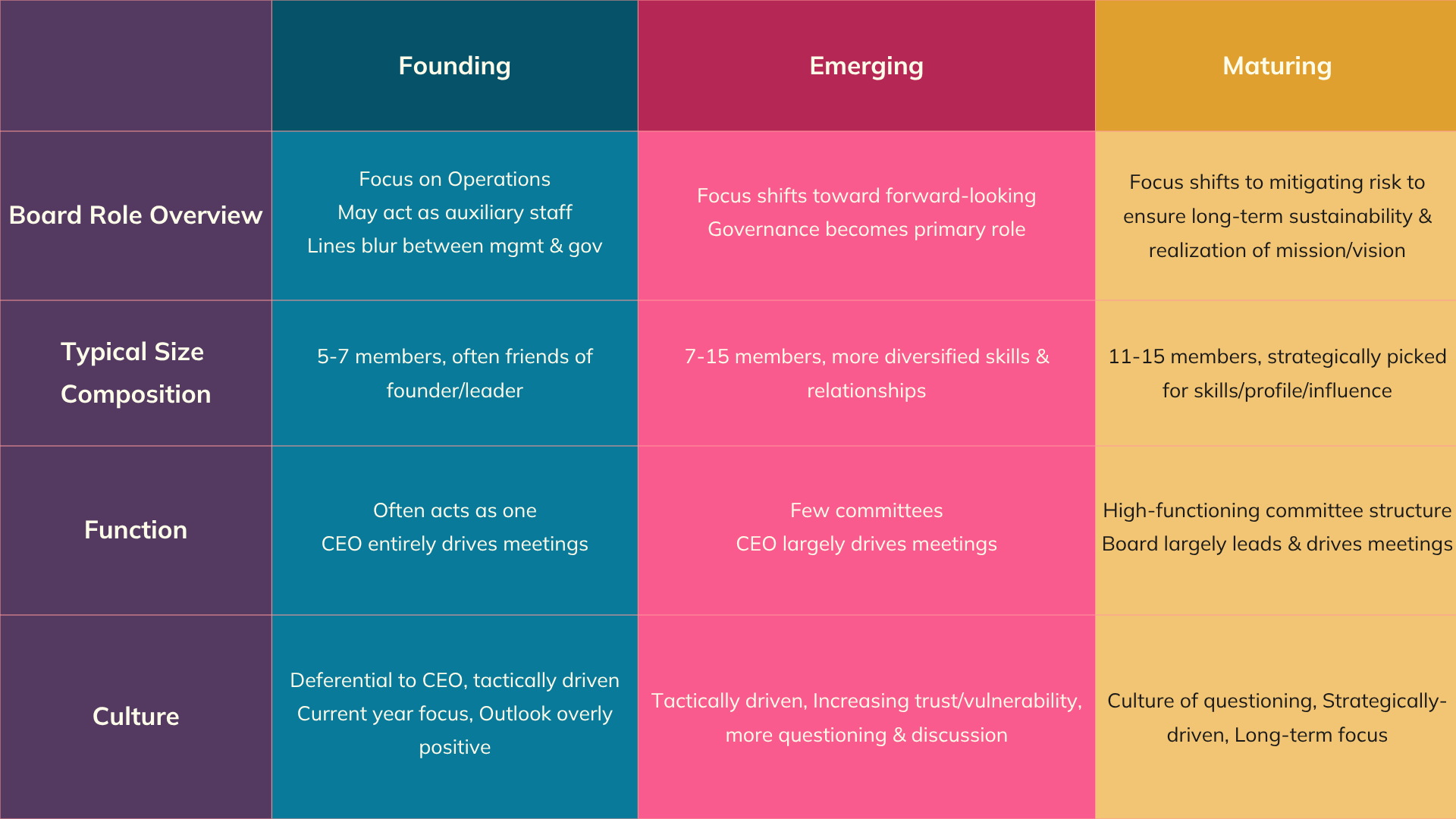
*Adapted from the original work of Marcia Aaron and the KIPP Foundation
Understanding your board's stage helps you calibrate your approach. You can't expect founding-stage behaviors from a maturing board, and you shouldn't impose maturing-stage expectations on a founding board that isn't ready.
Moving From Tactical to Strategic Questions
The key to engaging your board is asking questions that match their expertise and passion for your mission. But how do you frame these questions? I've found it helpful to think about five levels of organizational focus:
- Mission: What are we trying to achieve?
- Vision: What does the world look like when we've achieved it?
- Strategy: What's our plan to achieve it?
- Goals: How will we measure progress?
- Roadmap: What do we need to focus on this year to get there?
Your board should be most engaged at levels 1-4, with the executive team taking primary responsibility for level 5 execution.
Instead of spending time on operational updates, focus on essential questions like:
- Are we creating loving school cultures where students stay and thrive?
- Are our students learning and growing at the pace they need?
- Are our students prepared to lead choice-filled lives?
- Are we building responsible financial and talent models for sustainability?
These questions require board-level thinking. They connect to the big vision that drew your members to serve in the first place. They generate the kind of conversations that people leave feeling energized about.
The Framework for Better Board Engagement
Creating more strategic board engagement comes down to three key questions:
- How do you define success for, and with, your board?
- How do you align meetings to drive that success?
- How do you move from tactical to strategic questions?
The magic happens when you develop a small set of essential questions that meet four criteria:
- Simple: Easy to explain and remember (they need to be sticky)
- Relevant: Used by both management and the board
- Constant: Unchanging, or nearly so, over time
- Aligned: Supportive of realizing your mission and strategy
These questions can easily become the backbone of your board dashboards and drive your meeting agendas throughout the year.
Building a Committee Structure That Actually Works
Strong boards need strong committees, but committees only work when you have the right staff support and board leadership. You need a senior leader who can effectively run each committee and a board member who can roll up their sleeves and do the work alongside that staff member.
The magic happens when committees elevate big strategic questions for the full board to address. Each board meeting should start with committee reports—led by board members, not staff—that highlight key updates, upcoming decisions, and strategic questions that need broader input.
This simple shift makes meetings feel less CEO-driven and more board-owned. It distributes the work of governance across your leadership team while keeping everyone aligned on priorities.
The key is ensuring your committees are asking the right questions at the right time. Rather than following whatever data you happen to have available, drive from the essential questions that matter most to your mission, then calendar your year thoughtfully around when you'll have the information needed to answer those questions well.
Questions That Change Everything
As we wrapped up our workshop, several themes emerged from the conversations:
On board composition: "I've had the same board for 20 years with no movement. I'm realizing that might not be 100% good." Having long-term committed members is valuable, but you also need fresh perspectives and energy. Consider term limits that allow you to keep exceptional contributors while creating space for new voices.
On preparation: "Bad news ages poorly." Don't surprise your board with challenges. The more context and preparation you provide, the more strategic their contributions become. Your finance committee chair should never be surprised by budget issues. Your academic committee should understand student performance trends before they become crises.
On engagement: "I want to empower my board so they feel like they're leading meetings, not just receiving reports." This requires intentional development of both your staff team and board members. The goal is co-leadership where board and staff work together to drive meaningful conversations.
Making This Real in Your Context
Every school and organization is different, but the principles remain consistent:
- Take ownership of your board's effectiveness as the CEO
- Build the cool kids table by recruiting strong people who attract other strong people
- Partner closely with your board chair to set direction and manage governance
- Focus on strategic questions that energize and engage your members
- Prepare thoroughly so board members can focus on high-level thinking
- Use committees effectively to distribute work and develop leadership
- Connect everything back to your mission and vision for students
The work we do in education is too important for mediocre governance. Your board can be the difference between incremental improvement and breakthrough results for the students you serve.
About the Author
James Cryan is the founder and CEO of Willow Education, a purpose-driven career exploration and planning curriculum and platform. Formerly, he was the founder and former CEO of Rocky Mountain Prep, a high-performing network of charter schools in Colorado serving approximately 5,000 scholars. Under James’s leadership, RMP schools were recognized among the top-performing in the state and honored as one of Denver's Top 100 Workplaces. James has dedicated his career to giving all young people the opportunity to realize their full potential.